
Dealer Market Outlook: What July 2026 Affordability Trends Mean for Inventory Strategy
The dealer market outlook for July 2026 comes down to one shift: affordability isn’t breaking prices, it’s breaking deal structure.
Record monthly payments, longer loan terms, and rising negative equity are making deals harder to structure, even as retail asking prices remain steady. The solution isn’t cutting sticker prices. It’s restructuring the deal, leading with leasing when appropriate, and using data to engage customers before negative equity compounds.
A record payment on a four-year-low rate tells you where the problem lives
June’s average new-vehicle payment reached $813, a new June high, on an average APR of 6.7%, the lowest June rate since 2022, according to J.D. Power. Incentives climbed to $3,217 per unit, roughly 6.2% of MSRP. And 29.5% of trade-ins came in with negative equity, up 1.4 points year over year.
Read those numbers together and the diagnosis writes itself. When the rate hits a four-year low and the payment still sets a record, the principal is the problem, not the APR. And when principal is the problem, term is the wrong lever. Stretching the loan buys a lower payment by slowing equity build, and it does nothing for the nearly one in three customers who walk in already upside down.
One in four buyers is now on an 84-month loan. That’s not a fix. It’s a deferral.
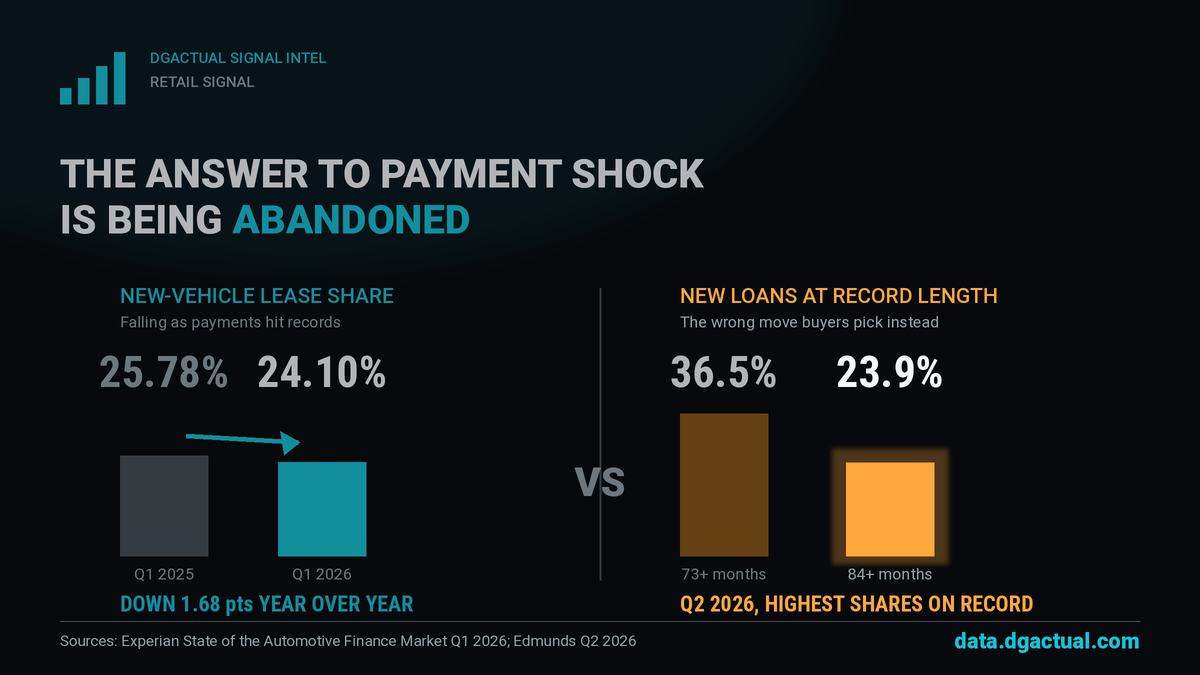
Q2 2026 set a record: 23.9% of new-vehicle loans ran 84 months or longer, per Edmunds. The average new-vehicle payment hit $777 on a record $44,156 financed. More than 20% of new buyers now carry a payment over $1,000 a month, and total interest on the average new loan works out to $9,811 at roughly 7% APR.
The 84-month term doesn’t solve affordability, it postpones it. Buyers trade a smaller payment for seven years of slow equity build, which raises the odds they come back underwater at trade time. That’s how negative equity compounds cycle over cycle, and it’s how a store’s future trade pipeline quietly erodes deal by deal.
Here’s the operational reality: every 84-month contract you write today is a customer who won’t be equity-ready for four to five years, unless you’re watching the data and reaching them first.
The one product built for this market is the one buyers are using less
A lease finances the depreciation, not the whole vehicle, and it hands depreciation risk back to the manufacturer instead of parking it on your customer’s next trade. In a payment-stretched, negative-equity market, that’s the tool.
The market is choosing the opposite. New-vehicle lease penetration fell to 24.10% in Q1 2026, down from 25.78% a year earlier, per Experian. Meanwhile a record 35.55% of new loans now run longer than six years. Buyers are buying the payment down with term, the one move that deepens the hole they’re already in.
The math on the desk isn’t subtle. Experian puts the monthly gap between leasing and buying at $151 in Q1 2026. On a payment-driven floor, $151 is the difference between a deal that pencils and one that walks.
Want proof the tool works when it’s used on purpose? Look at EVs. More than 56% of EV shoppers lease, and EVs now make up 25.31% of the total new-lease market, up from 17.69% a year ago. Where leasing is presented deliberately, it dominates. It’s being worked hard in one lane and ignored everywhere else.
Two things a lease does that an 84-month note can’t:
- It gives negative equity a finish line. Roll the underwater balance into the lease and it’s extinguished when the lease ends, instead of carried forward into the next loan, stacked on top of new depreciation.
- The approval math often favors it. Captive lenders will frequently buy a stretched customer at a better tier on a lease than on a prolonged finance term, if they buy the long term at all.
What this means for inventory strategy
Retail asking prices are holding while demand softens, that’s the read from DGActual’s DARPI index, built from more than 40 million active dealer listings. Prices holding while traffic cools is not the same market as prices falling — and the wrong read leads to the wrong play. When demand is the constraint and price is not, the store that wins is the one that stays disciplined on price and manages days-on-market, turn, and equity, not the one that pre-emptively cuts.
That read should shape acquisition too. When turn slows, the cars you stock matter more than the cars you mark down, and your own customer database is the acquisition channel with the best margins in it. Every long-term contract, service customer, and past buyer in your DMS is a sourcing opportunity your competition can’t see.
Three Strategies Dealers Should Prioritize Right Now
- Put a lease payment next to every long-term loan quote — not just units with subvented money — and let the customer choose on the math.
- Make the equity conversation explicit. An 84-month term should read as what it is: a slower road back to positive equity.
- Build a re-marketing cadence off your data. Reach customers at year three with a data-backed equity check and you’re sourcing inventory and repeat deals before your competition knows the customer exists.
Affordability isn’t going to resolve itself this quarter. The stores that win it won’t be the ones with the lowest sticker. They’ll be the ones structuring smarter deals today and mining their own data for the next one.
The bottom line
As Daniel Govaer’s DGActual data illustrates, today’s market isn’t signaling a pricing correction—it’s signaling an affordability challenge. Dealers that stay disciplined on pricing, structure smarter deals, and proactively identify equity opportunities through their own customer data will be better positioned to drive inventory turn and profitability as market conditions evolve.
FAQ’s

Right on Cue
get in the game
Sign up for our newsletter to get regular updates on new, resources, partnerships, features, and other important announcements from VINCUE.
Related Content


Our Dealers Can’t Stay Quiet on Google

Launched VINCUE a couple months ago for our dealership as we were previously on vAuto. We love the pricing, software, and the support team is engaging with a lot of new features coming. It was a GREAT decision to switch from vAuto to VINCUE and we are very happy with the new software and support team.
Brandon Bizzell
General Manager
The Faricy Boys Chrysler Jeep
Salida, CO

New to the VINCUE family, and I’m very impressed with the immediate support provided by the team. Charlie Basham has been a key factor in getting the dealership started on a great path with the VINCUE system. He has been very responsive to my questions and has made sure I can navigate the key reports and understand the process used. Cheyenne Currier has also been very responsive with merchandising uploads needed by the dealership. I look forward to working with the VINCUE Team in the future.
Lynn Burns
Used Car Manager
Sierra Toyota
Sierra Vista, AZ

Was previously with another provider for 16 years but now have been with VINCUE for 6 months and I absolutely love it and would never go back to my old provider. Even if you’re not considering making any changes right now, this is one I would look into and you won’t regret it! What I realized is how behind the times my previous provider is and I didn’t even realize it until I learned about VINCUE!
Mark Owen
General Manager
Cable Dahmer Automotive
Kansas City, MO