
The FTC’s New Playbook for Auto Dealers — And the Payday Lender Who Made It Possible
Most dealers heard that the CARS Rule got vacated in January 2025 and moved on. Case closed, FTC defanged, back to business.
That read was wrong. The CARS Rule is gone. AMG Capital gutted the FTC’s ability to collect money. And yet the agency still has teeth, because of a 112-year-old law, a unanimous Supreme Court ruling, and 86,000 consumer complaints.
Here’s how we got here.
A Payday Lender From Kansas Changed Everything
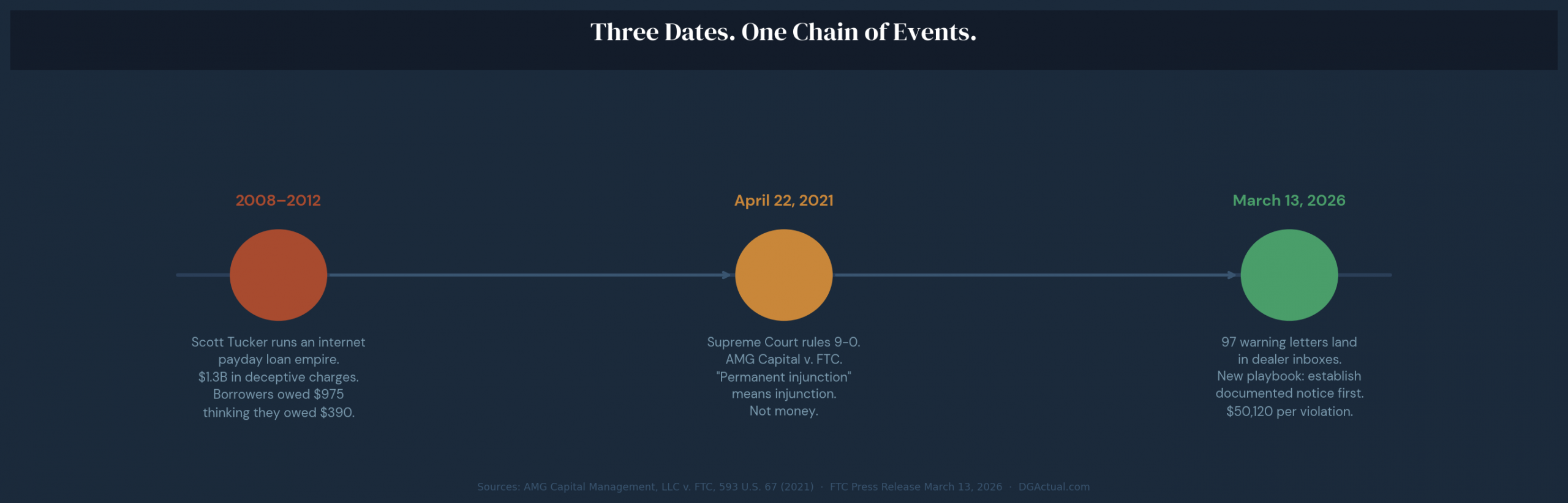
His name was Scott Tucker. Race car driver from Leawood, Kansas. Fire suits on weekends, internet payday loan empire during the week. Between 2008 and 2012, Tucker’s companies, Ameriloan, OneClickCash, 500FastCash, issued more than 5 million short-term loans. The scheme was precise. A customer borrowed $300. The written disclosure said they could repay $390.
Clean. Simple. Done. Except it wasn’t.
Buried in the loan documents was an automatic renewal clause. Unless the customer actively opted out, the loan renewed. And renewed. And renewed. That $390 total became $975. The customer paid more than twice what the document showed. The FTC sued Tucker in 2012 under Section 13(b) of the FTC Act. He was ordered to pay $1.27 billion, the largest consumer protection recovery in agency history. Then it went to the Supreme Court.
On April 22, 2021, nine justices, unanimous, reversed. AMG Capital Management, LLC v. FTC, 593 U.S. 67 (2021). The holding: Section 13(b) authorizes a permanent injunction. That means an injunction. It does not mean money. It never meant money. A payday lender from Kansas City accidentally rewrote how the federal government can police car dealers. Forever.
What the FTC Has Left — And Why It’s Enough
Section 5 of the FTC Act. Enacted in 1914. Never weakened by AMG Capital. Never touched by the Fifth Circuit. A blanket prohibition on unfair or deceptive acts or practices that has sat in federal law for 112 years and is fully operational right now.
Here’s the mechanism that makes it dangerous post-AMG:
Under Section 5(m)(1)(B), once a company has documented notice that a practice is prohibited, the FTC can pursue civil penalties of up to $50,120 per violation, per transaction.
The warning letter is that notice. Before the letter: injunction only. No money. After the letter: up to $50,120 per deal where violations continue. A dealer doing 200 transactions a month does that math fast.
What the 97 Letters Actually Say
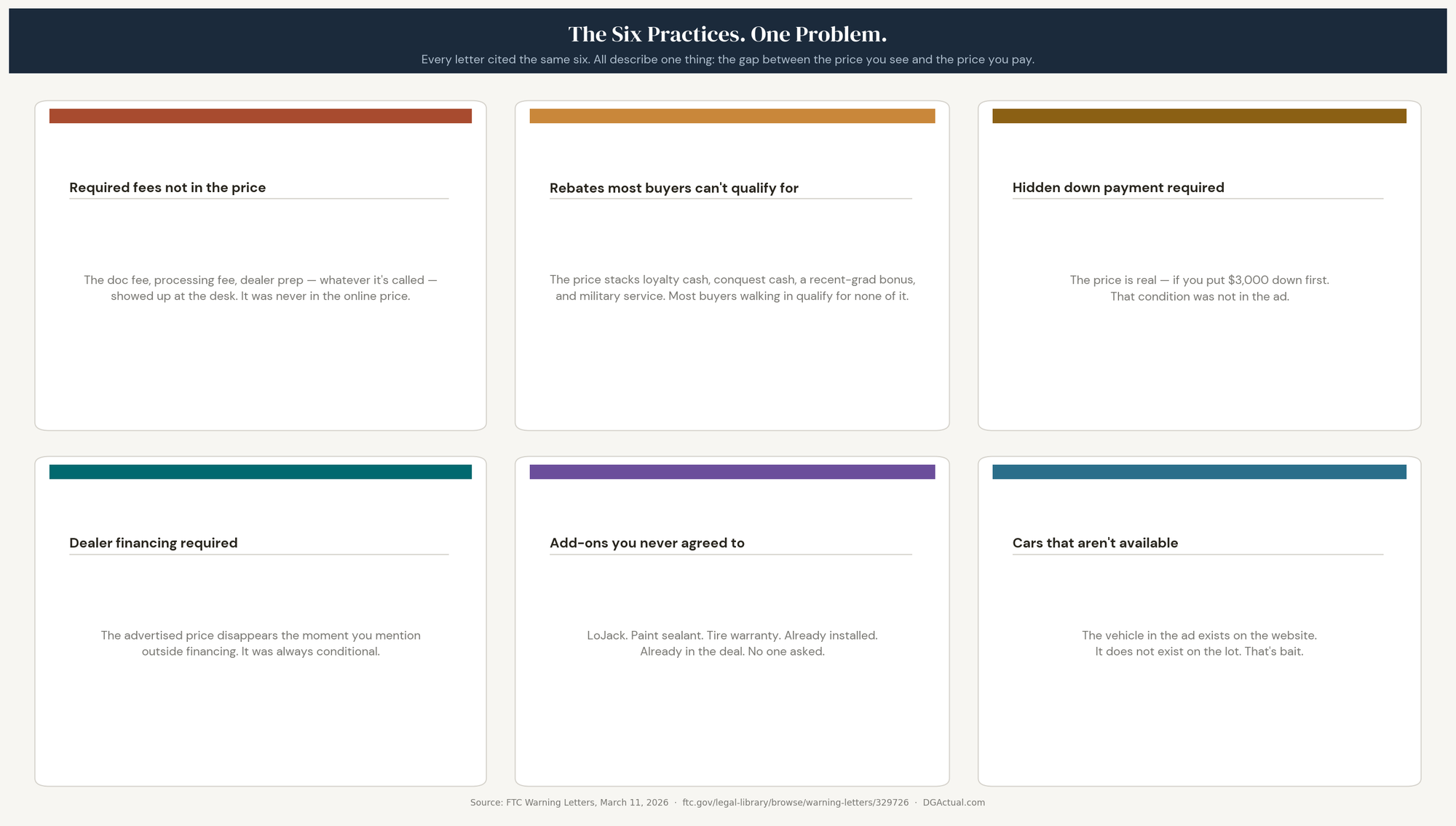
Every letter is substantively identical. Same six practices. Same body text. Same three enforcement cases in the footnotes. Only the name and address change.
The six practices:
Six practices. One through line: the gap between the price advertised and the price collected.
This is exactly the problem that real-time market pricing tools exist to solve, not just for compliance, but because a price that means something to a buyer is a price that closes. When the advertised number and the desk number don’t match, you lose the deal before it starts. The FTC is now attaching a dollar figure to that gap too.
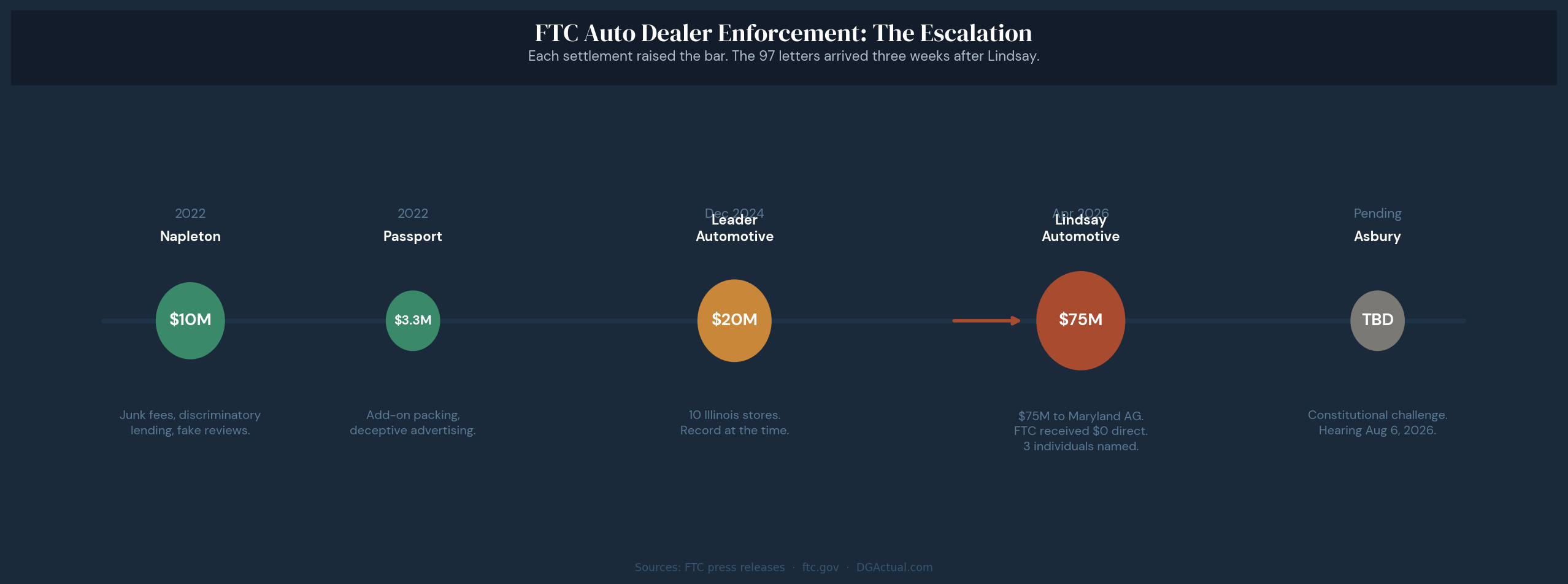
The footnotes cite three live enforcement actions: Lindsay Automotive Group, Leader Automotive Group, and Asbury Automotive Group. Not hypothetical. Real cases, real money, real injunctions.
85% Franchise Dealers — And What the Brand Data Reveals
Of the 97 dealers, 82 are franchised new-car dealers. Four publicly traded groups received letters: AutoNation, Group 1 Automotive, Lithia Motors, Sonic Automotive. Berkshire Hathaway Automotive is on the list. Asbury and Penske are not, Asbury is already in active litigation.
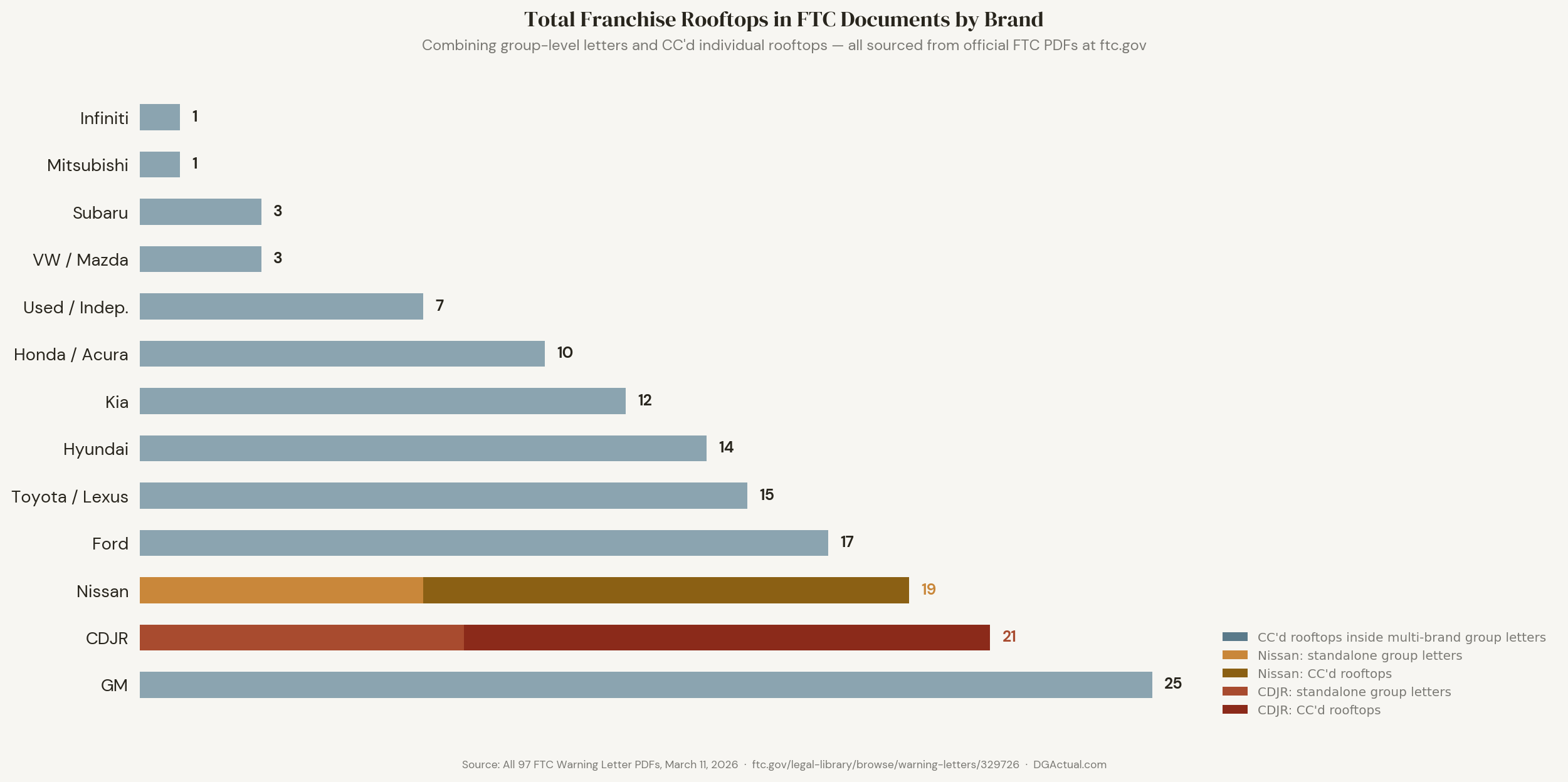
133 individual rooftops appear across the 97 letters when you read the cc: sections. Nissan: 19 total locations across 9 dealer groups. CDJR: 21 total locations across 9 dealer groups. The complaint data didn’t stay at the corporate level. It pointed to specific addresses in specific markets. The brand breakdown isn’t random, it tracks directly to MAP pricing.
Brands with Minimum Allowable Advertised Price programs (Honda, Toyota, Nissan, Mercedes-Benz, Lexus, among others) have OEM compliance infrastructure that flags pricing issues before a consumer complaint reaches federal regulators. Toyota’s three-strike system, loss of trip eligibility, suspended marketing support, enhanced monitoring, is a first line of defense the FTC never has to touch.
Nissan has MAP. And still has 19 locations in FTC documents. The tension: Nissan’s stair-step incentive stack layers conquest cash, loyalty rebates, regional programs, and fleet money on top of each other. An advertised price technically achievable for one buyer isn’t achievable for most. That’s practice number 2.
Stellantis has no MAP pricing at all, and reported a 22.3 billion euro net loss for 2025, its first annual loss in company history. Dodge down 28% in sales. 142 days supply. Industry average: 78. Toyota: 36. Without a MAP floor and facing that kind of inventory pressure, the structural incentive to advertise the sharpest possible number is obvious. Whether every buyer can get that number is exactly the FTC’s question.
What Full Enforcement Actually Looks Like
The three cases in every letter’s footnotes are the FTC showing recipients what comes next.
Lindsay Automotive: 88% of buyers paid more than $2,000 over the advertised price. 68% were charged for at least one add-on they didn’t consent to. $75 million in consumer restitution. $3.1 million civil penalty. Owner, COO, and a former GM named personally.
Leader Automotive: $20 million. Bait-and-switch internet pricing, mandatory pre-installed add-ons, fake reviews to suppress complaints. Ten Illinois stores. VP of U.S. operations charged separately.
Asbury: Still in litigation. Three Texas stores. Constitutional challenge pending. Hearing set for August 6, 2026.
One important note: the $75 million in Lindsay restitution went to the Maryland Attorney General — not the FTC. AMG Capital is why. The agency still can’t collect money directly. But after a warning letter, civil penalties under Section 5(m)(1)(B) are a different story.
The Compliance Standard Is Simple to State
The advertised price is the price any consumer can pay, excluding only government-imposed fees like taxes and title. Everything else goes in the number. Not the footnote. In the number.
A price that requires dealer financing to access is not the price. A price built on incentive stacking most buyers can’t qualify for is not the price. Add-ons require express consumer consent before the charge appears.
Social media is not exempt. An Instagram post with a price is an advertisement. A third-party platform listing is an advertisement. The digital footprint is permanent.
The Database That Built the Case
The FTC’s Consumer Sentinel Network logged 60,189 auto dealer fraud complaints in 2024. Then 86,000 in 2025, a 43% surge in one year.
Automobile complaints have topped the Consumer Federation of America’s annual ranking for nine consecutive years. The FTC did not go looking for a fight. The complaints built the case.
And the selection criteria for the 97 letters are nonpublic. The FTC hasn’t said whether the dealers on the list were the only ones engaged in the six practices described. The complaint database reflects who filed, not necessarily who had the highest underlying rate of violations.
The warning letters represent documented knowledge for 97 operators. The practices they describe did not originate on the date of the letters.
The bottom line
Daniel Govaer is EVP of Product at VINCUE and a former award-winning Mercedes-Benz General Manager. Read more of his work at dgactual.com. If you want to talk through how your pricing and deal structure holds up against the FTC’s six practices, reach out to your VINCUE Performance Manager.

Right on Cue
get in the game
Sign up for our newsletter to get regular updates on new, resources, partnerships, features, and other important announcements from VINCUE.
Related Content



Our Dealers Can’t Stay Quiet on Google

Launched VINCUE a couple months ago for our dealership as we were previously on vAuto. We love the pricing, software, and the support team is engaging with a lot of new features coming. It was a GREAT decision to switch from vAuto to VINCUE and we are very happy with the new software and support team.
Brandon Bizzell
General Manager
The Faricy Boys Chrysler Jeep
Salida, CO

New to the VINCUE family, and I’m very impressed with the immediate support provided by the team. Charlie Basham has been a key factor in getting the dealership started on a great path with the VINCUE system. He has been very responsive to my questions and has made sure I can navigate the key reports and understand the process used. Cheyenne Currier has also been very responsive with merchandising uploads needed by the dealership. I look forward to working with the VINCUE Team in the future.
Lynn Burns
Used Car Manager
Sierra Toyota
Sierra Vista, AZ

Was previously with another provider for 16 years but now have been with VINCUE for 6 months and I absolutely love it and would never go back to my old provider. Even if you’re not considering making any changes right now, this is one I would look into and you won’t regret it! What I realized is how behind the times my previous provider is and I didn’t even realize it until I learned about VINCUE!
Mark Owen
General Manager
Cable Dahmer Automotive
Kansas City, MO