
EV Battery Scores: Modeled or Measured?
As part of our UNITE Partner Program, we’re sharing new research from Lyteflo, whose EV battery diagnostics help dealers appraise and sell used EVs with confidence. Their study of 150 vehicles found that model-based battery scores overstated actual battery health by an average of 6.2 points — a gap that hits dealers directly in appraisal, pricing, and post-sale liability. Lyteflo’s battery intelligence is available directly inside VINCUE through our integration. Here’s the full report.
Originally published by Lyteflo on June 22, 2026. Republished with permission as part of the VINCUE UNITE Partner Program.
Summary
Dealers relying on model-based scores are vouching for a guess.
The battery is the most expensive component of an EV, so when buying a used EV, the first question is often: what’s the health of the battery? Increasingly, dealers answer that question with an independent third-party score on the Vehicle Detail Page. The problem is the integrity of the data behind that score.
Many dealers are relying on model-based estimates: a statistical guess at the health of the battery based on aggregated data from similar vehicles. The result is a “score” inferred without ever measuring data from the vehicle itself.
We analyzed battery degradation from 150 vehicles using Lyteflo’s battery certification test, measured directly from the vehicle’s onboard diagnostic data, and compared the result to the exact same vehicle’s “range score” from the battery report of a well-known model-based product.
The Findings
Model-based approach overstates scores on every cohort.
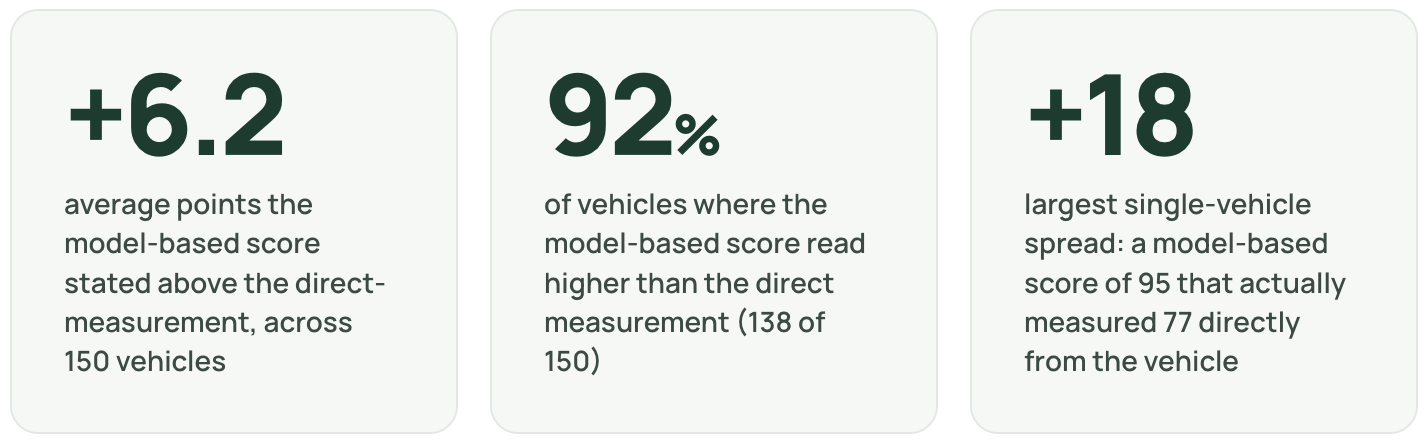
When comparing the direct-measurement method to the model-based method on 150 vehicles, we found that the model-based estimate overstated the score by 6.2 points on average.
Furthermore, the model-based estimate read higher than the direct-measurement on 92% of vehicles and exhibited a maximum overstatement of 18 points: issuing a score of 95 on a 2022 Tesla Model Y that actually reported a score of 77 using the direct-measurement method.
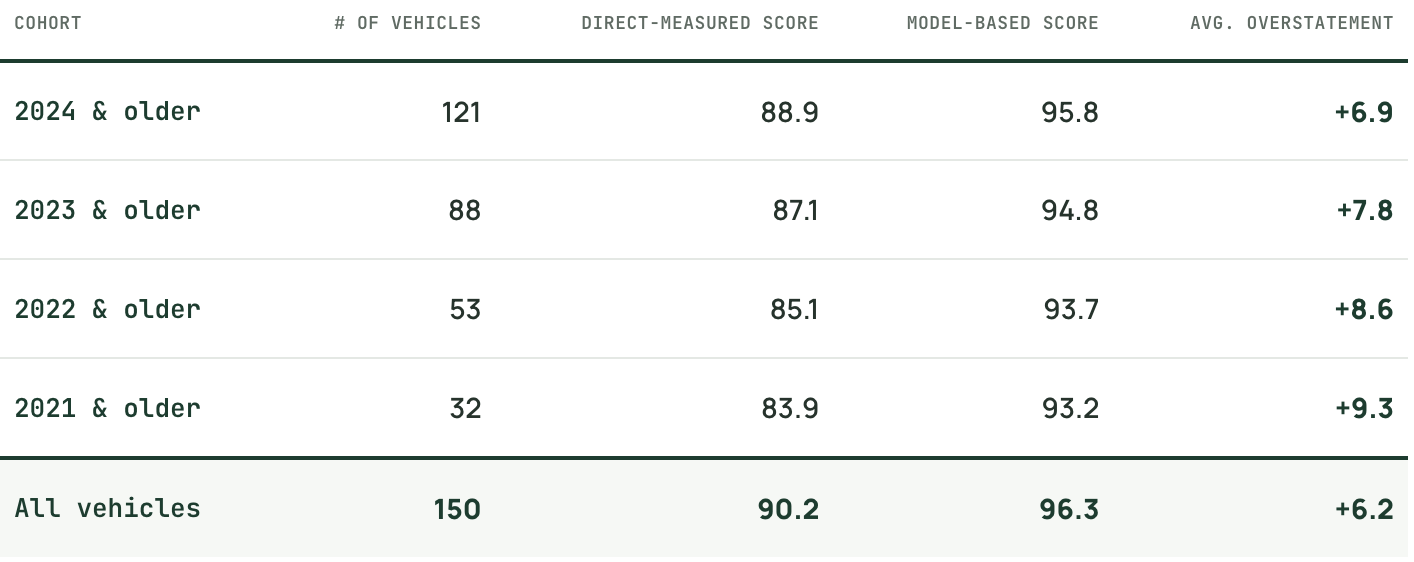
Reading the table. Each cohort is cumulative (e.g. “2022 & older” includes all vehicles model year 2022 and earlier). Scores are 0 to 100; average overstatement is the model-based score minus the direct-measured score, averaged across the cohort. The sample is approximately 57% Tesla.
What the score represents
A range estimate, read as a health score.
The model-based estimate is presented as a “range score,” while the direct measurement is presented as a state of health, representing a measured indicator of the actual degradation of the battery’s cells.
Dealerships and shoppers, however, may not fully understand the distinction. Many will interpret the model-based estimate as a battery state of health representing the degradation of the battery, when in fact it is a prediction of driving range built from external assumptions.
Cell-level condition is invisible to a model.
Battery health problems usually begin at the cell level, a single weak cell or growing imbalance, long before they appear as lost range. Cell voltages and cell-to-cell variance can only be read directly from the battery management system. They cannot be derived from mileage, age, or climate, so a model built on those inputs is blind to the exact faults that produce post-sale failures.
The bottom line
An optimistic guess becomes the dealer’s exposure.
A model-based score is a prediction, not a measurement, and across 150 vehicles it ran 6.2 points optimistic, with gaps as high as 18 points. Such an overstatement is not trivial. It flows directly into how a vehicle is priced and represented to the buyer.
The exposure shows up in three places:
The Takeaway for Dealers
Every EV on your lot carries a number someone will trust — a buyer, an appraiser, or you. This research makes the stakes clear: a modeled score can run points higher than what the battery actually reports, and that gap lands on the dealer at appraisal, at the point of sale, and after it. Vehicle-specific battery data inside your workflow is how you close it. Read the original study at news.lyteflo.com.
Right on Cue
get in the game
Sign up for our newsletter to get regular updates on new, resources, partnerships, features, and other important announcements from VINCUE.
Related Content






Our Dealers Can’t Stay Quiet on Google

Launched VINCUE a couple months ago for our dealership as we were previously on vAuto. We love the pricing, software, and the support team is engaging with a lot of new features coming. It was a GREAT decision to switch from vAuto to VINCUE and we are very happy with the new software and support team.
Brandon Bizzell
General Manager
The Faricy Boys Chrysler Jeep
Salida, CO

New to the VINCUE family, and I’m very impressed with the immediate support provided by the team. Charlie Basham has been a key factor in getting the dealership started on a great path with the VINCUE system. He has been very responsive to my questions and has made sure I can navigate the key reports and understand the process used. Cheyenne Currier has also been very responsive with merchandising uploads needed by the dealership. I look forward to working with the VINCUE Team in the future.
Lynn Burns
Used Car Manager
Sierra Toyota
Sierra Vista, AZ

Was previously with another provider for 16 years but now have been with VINCUE for 6 months and I absolutely love it and would never go back to my old provider. Even if you’re not considering making any changes right now, this is one I would look into and you won’t regret it! What I realized is how behind the times my previous provider is and I didn’t even realize it until I learned about VINCUE!
Mark Owen
General Manager
Cable Dahmer Automotive
Kansas City, MO