

Two Inflation Numbers and a Gloomy Country That Keeps Shopping
Picture a general manager at 7:15 on a Monday, coffee in hand, scrolling past two headlines. One says inflation is 3.7%. The other says the Fed is watching a different inflation number, and that one just got quietly rewritten. A few swipes later, a survey says Americans have almost never felt worse about the economy, and a retail report says they spent more last month than the month before. Two stories, both of them confusing. We get asked about both constantly, so this week we are doing something different: two features, no weekly stat parade.
Feature one: Two inflation numbers, and the Fed picked the quiet one
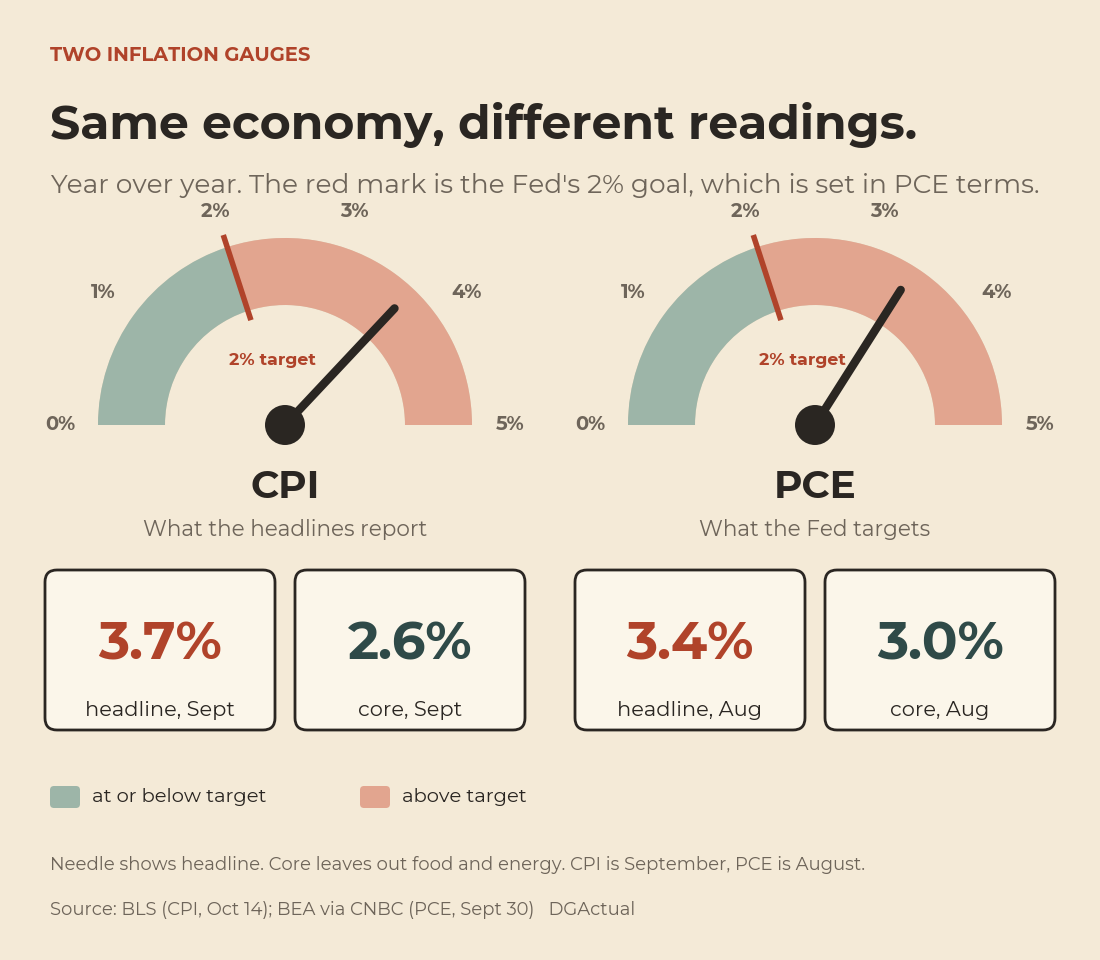
Every month the government publishes the number that makes headlines: the consumer price index, or CPI. In September it showed prices up 3.7% from a year earlier. It is the figure most headlines quote, and it is not the one the Federal Reserve is graded on.
Policymakers watch a cousin, the personal consumption expenditures price index, or PCE, built by a different agency. The Fed’s 2% goal has been written in PCE terms since January 2012, so when you hear that the Fed wants inflation at 2%, it means PCE at 2%. That is why Thursday’s PCE report matters so much to the people watching the Fed.
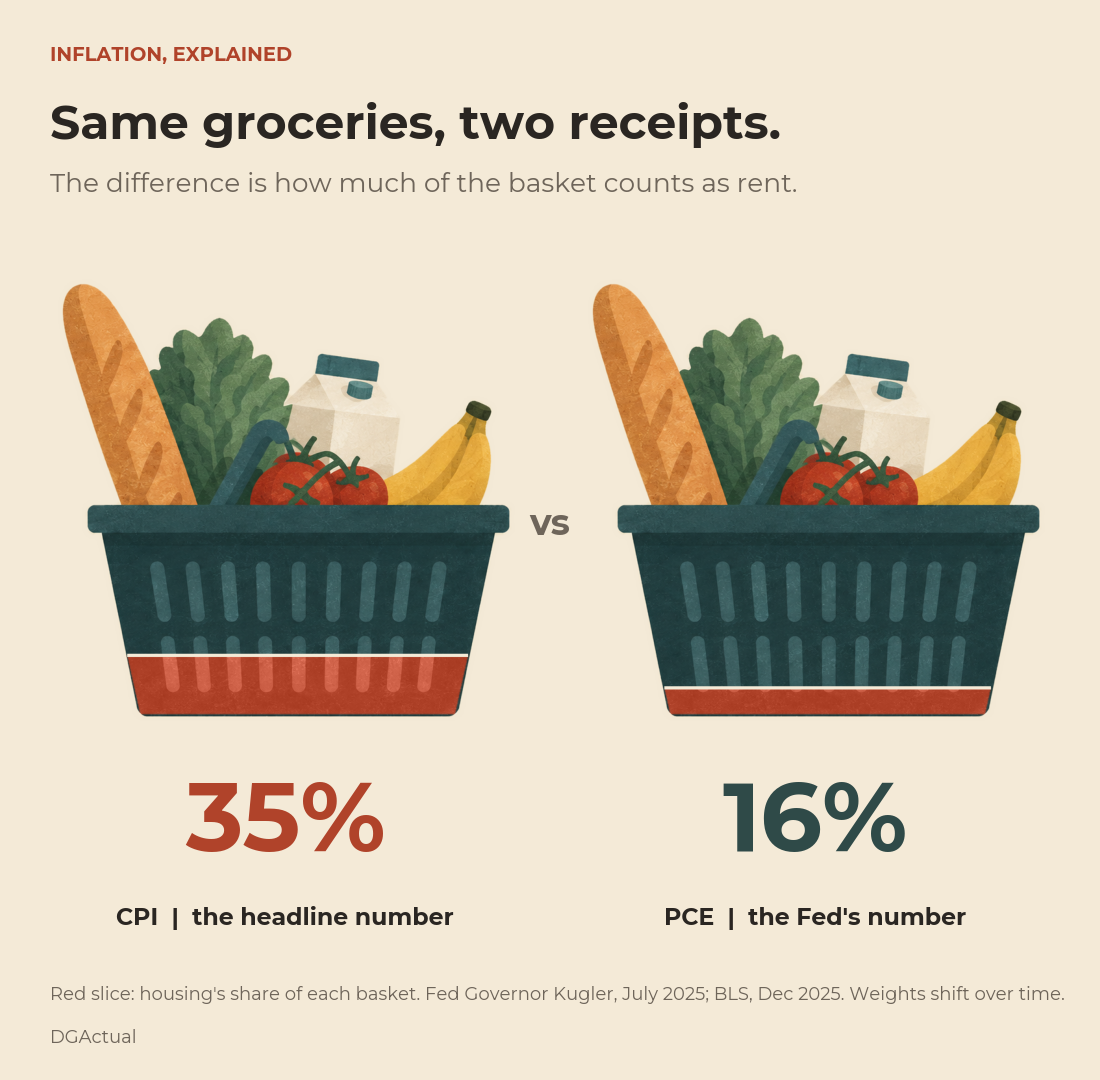
Why would two measures of the same economy disagree? The Fed points to three things: what each one counts, how much each item weighs, and how quickly each adjusts when shoppers change their habits. Weights turn out to matter more than you might expect. A San Francisco Fed analysis of data since 2011 found that weights explain an average of 0.56 percentage points of the gap between the two, against 0.14 for the way prices are averaged. The clearest example is the roof over your head. Shelter makes up about 35% of the CPI basket and about 16% of the PCE basket, according to a Fed governor’s July 2025 speech and BLS data.
Put those differences together and PCE almost always runs cooler than CPI. This month, on core readings, it did not. Core PCE for August sits above core CPI for September, a hint rather than a measurement, since the months differ. But a gauge that usually runs cooler is reading higher, and the reason is stranger than the economy: a change in how the number is built.
The revision that changed history without changing a price
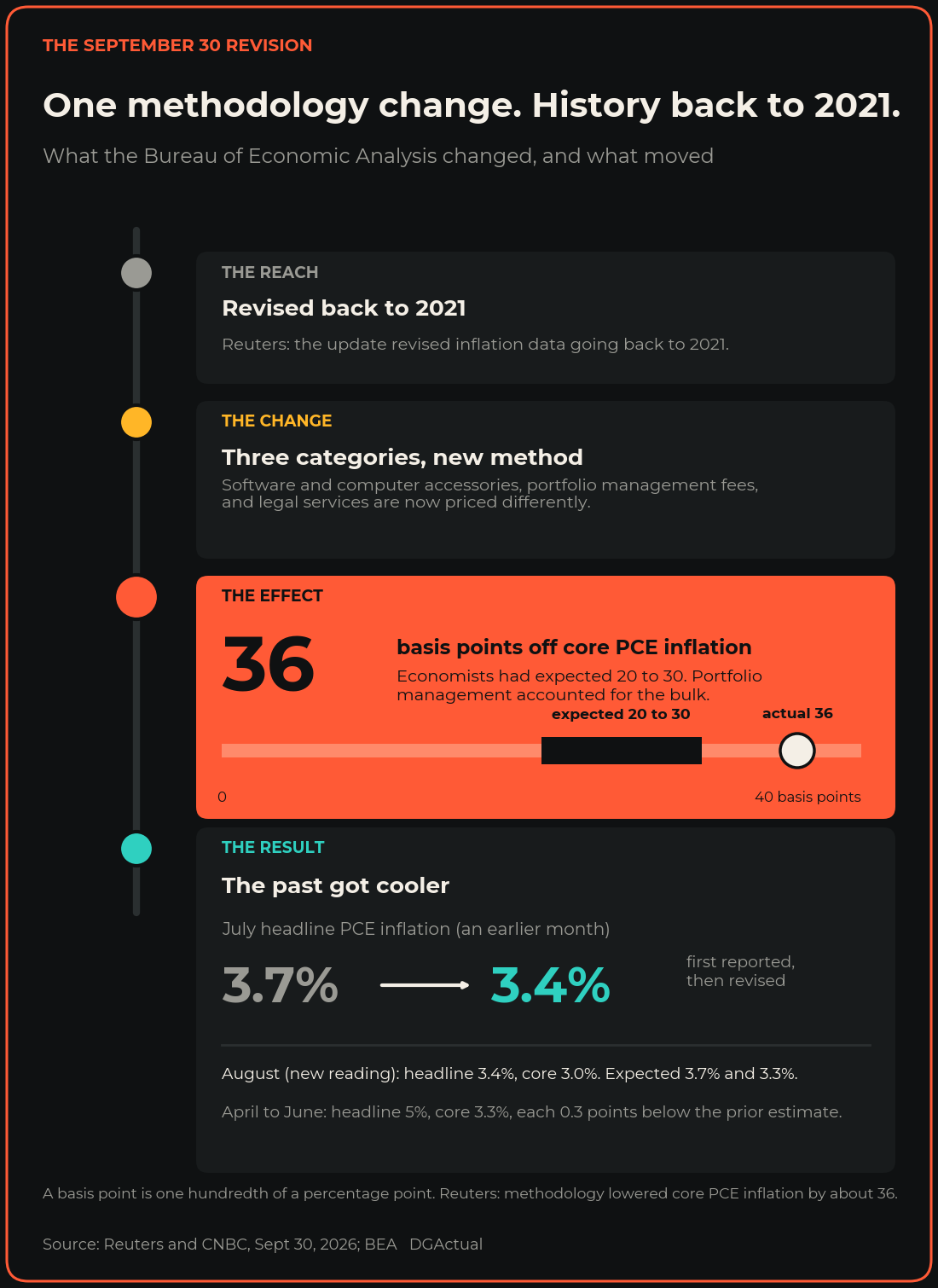
On September 30 the Bureau of Economic Analysis released August’s PCE along with a methodology update. It changed how the agency computes prices for legal services, software and computer accessories, and portfolio management. The effect was large. Methodology changes lowered core PCE inflation by about 36 basis points, well above what economists had expected, and Reuters reports that portfolio management services accounted for the bulk of it. The revision reached all the way back to 2021.
Nobody’s grocery bill changed that day. A statistical agency changed how it measures a few categories, and the official past got cooler. We could not find a primary source that explains why portfolio management moved so much, so we will not guess at the mechanism. What the episode shows is that inflation is partly a measurement decision, not only a thing that happens to us.
The reaction was not relief. Heather Long, chief economist at Navy Federal Credit Union, said the data showed no progress in August on inflation. Sonu Varghese of Carson Group said that even after major methodological revisions, PCE inflation is still running hot however you cut it. Our read: both can be true. The number got friendlier, and the level is still well above 2%.
What to watch Thursday
Thursday’s report lands after the Fed’s Wednesday decision, not before it. Economists surveyed by the Associated Press expect headline PCE to rise from 3.4% to 3.7%, which would put it level with September’s headline CPI.
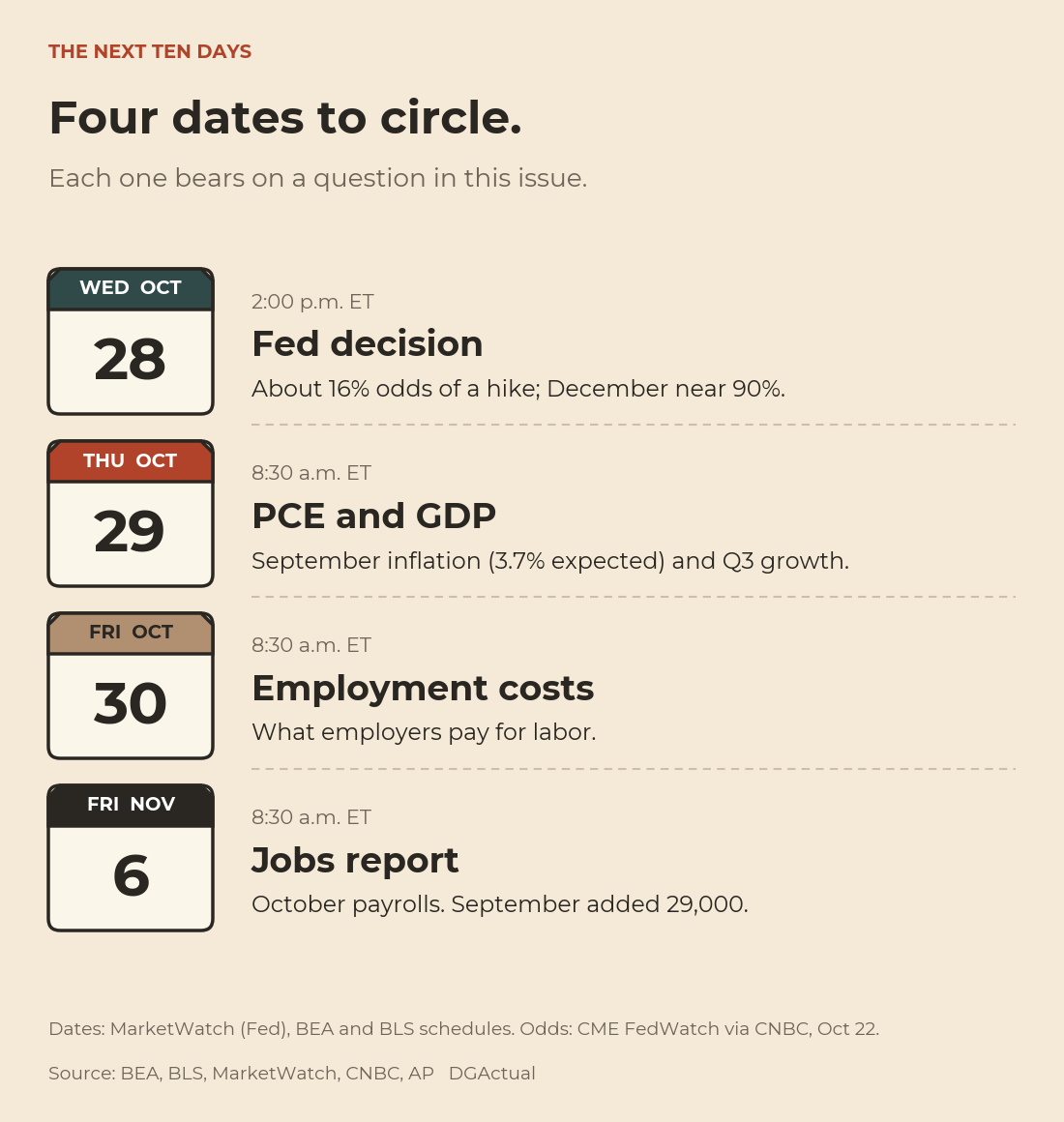
Here is how we will read it. A core PCE print below August’s 3.0% would suggest the revision, not the economy, is doing the cooling. A print above the 3.3% economists expected for August would suggest that softness was a one-month dip. Either way, be wary of anyone selling certainty about it this week.
Feature two: Gloomy, but still spending
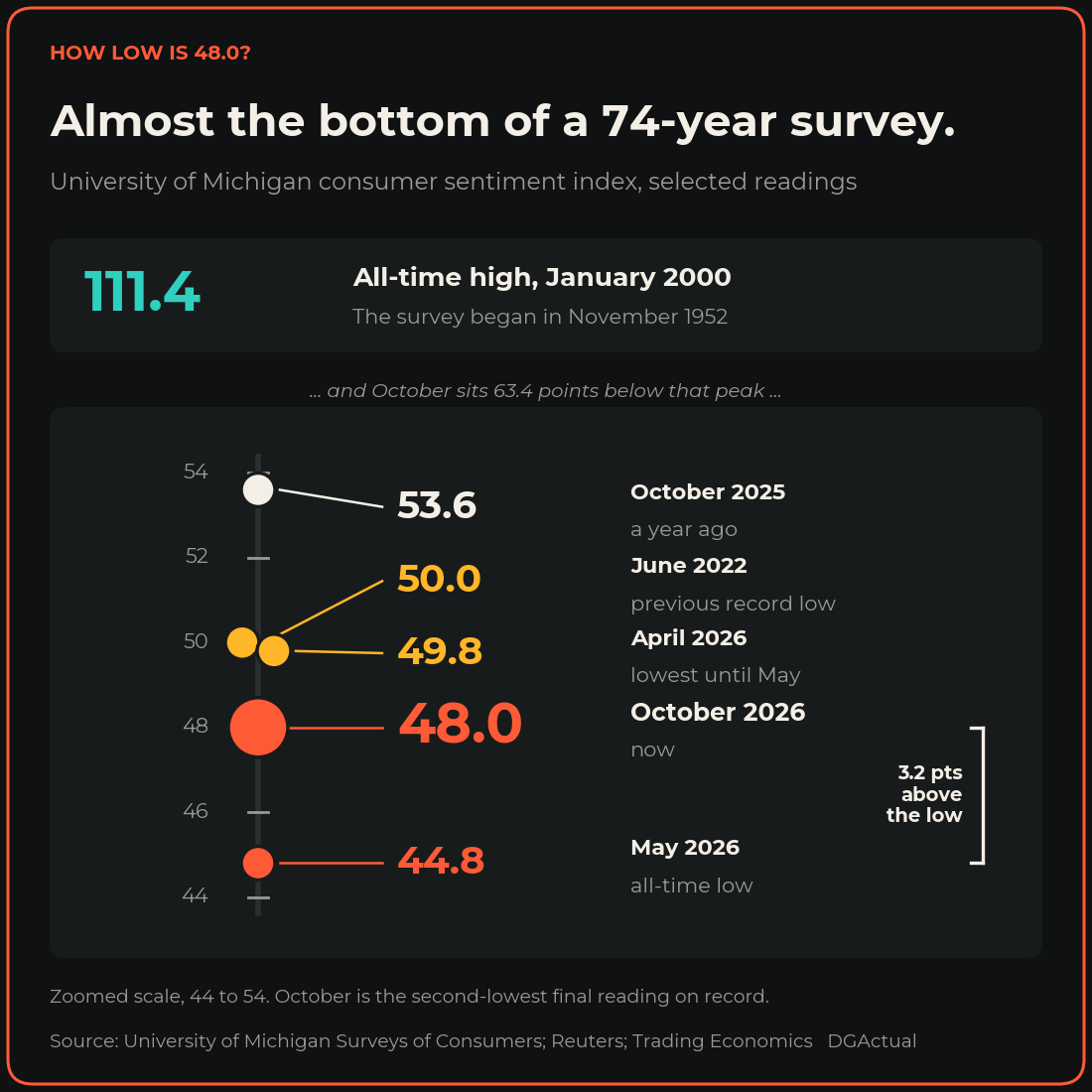
Start with the mood, because it is dark. The University of Michigan’s consumer sentiment index finished October at 48.0, the second-lowest reading in a survey that began in 1952. Only May was worse, not long after the Iran war began. People expect prices to rise 4.7% over the next year and 3.5% a year over the next five. Joanne Hsu, who directs the survey, put it this way: purchasing power continues to dominate consumer views of the economy.
Now watch what those same people did in September, after a war in the Middle East had already pushed up what they pay for fuel. Retail and food services sales hit $745.0 billion, the Census Bureau says, up 6.3% from a year earlier. Feeling terrible and spending freely, in the same country, in the same month. That is the puzzle.
Look one layer down and the picture changes. Strip out gas stations and the month’s gain shrinks to a sliver, while gas station sales alone jumped. Oxford Economics chief U.S. economist Michael Pearce said the large jump in the headline was almost entirely due to rising gasoline prices.
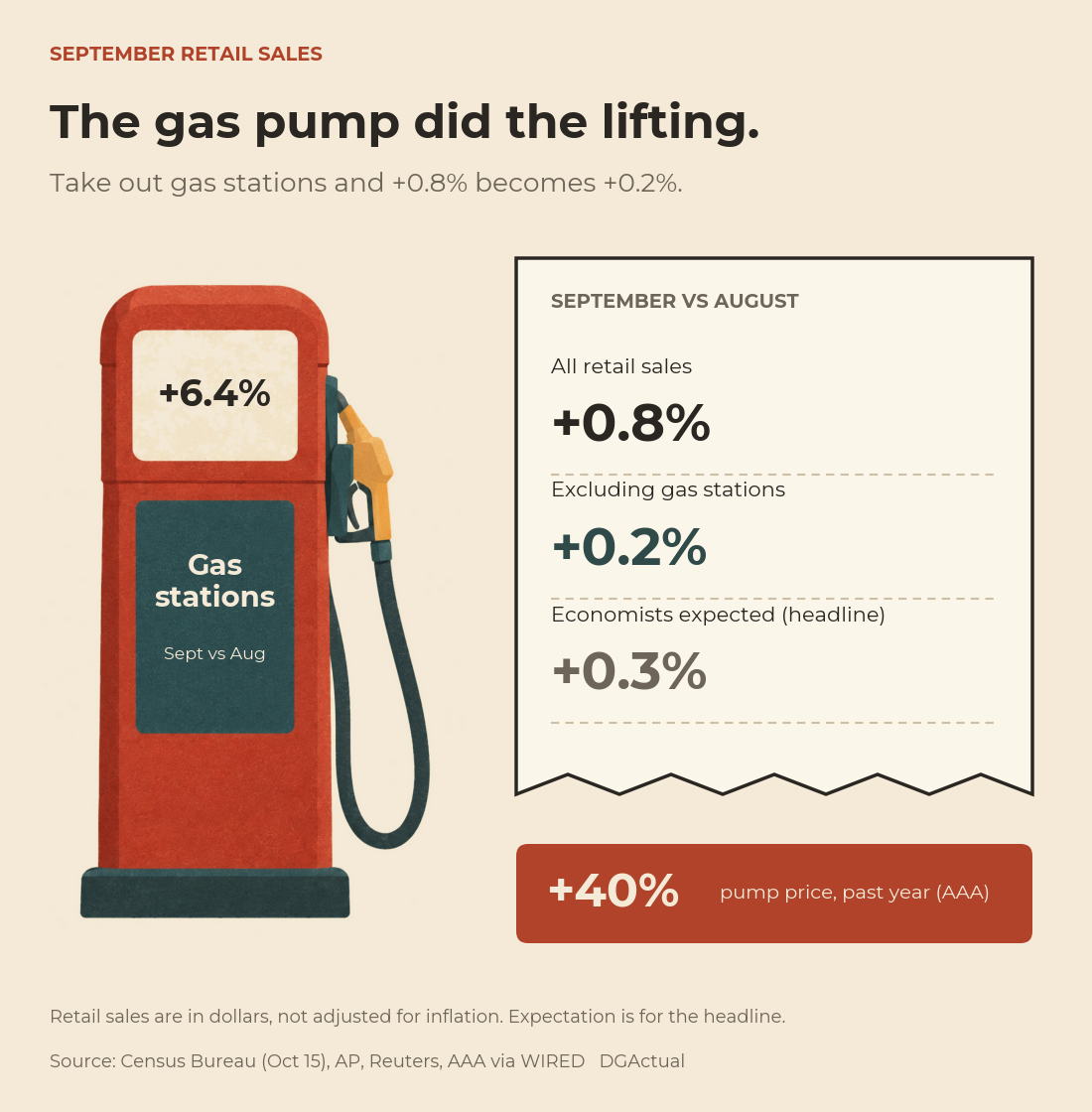
That is the first half of the answer. Retail sales are counted in dollars and are not adjusted for inflation, so the same trip to the station shows up as more spending without anyone buying more. The cause, AP reports, is the U.S. war with Iran, which started in February and has all but shut the Strait of Hormuz, the narrow waterway much of the world’s oil passes through. The gloomy mood and the big receipts are describing the same squeeze.
The second half is the more important one, and it comes from the Bureau of Economic Analysis. Households spent more than they took home, and the gap had to come from somewhere. Part of it shows up in the saving rate, which fell to its lowest since November 2022, Reuters reports.
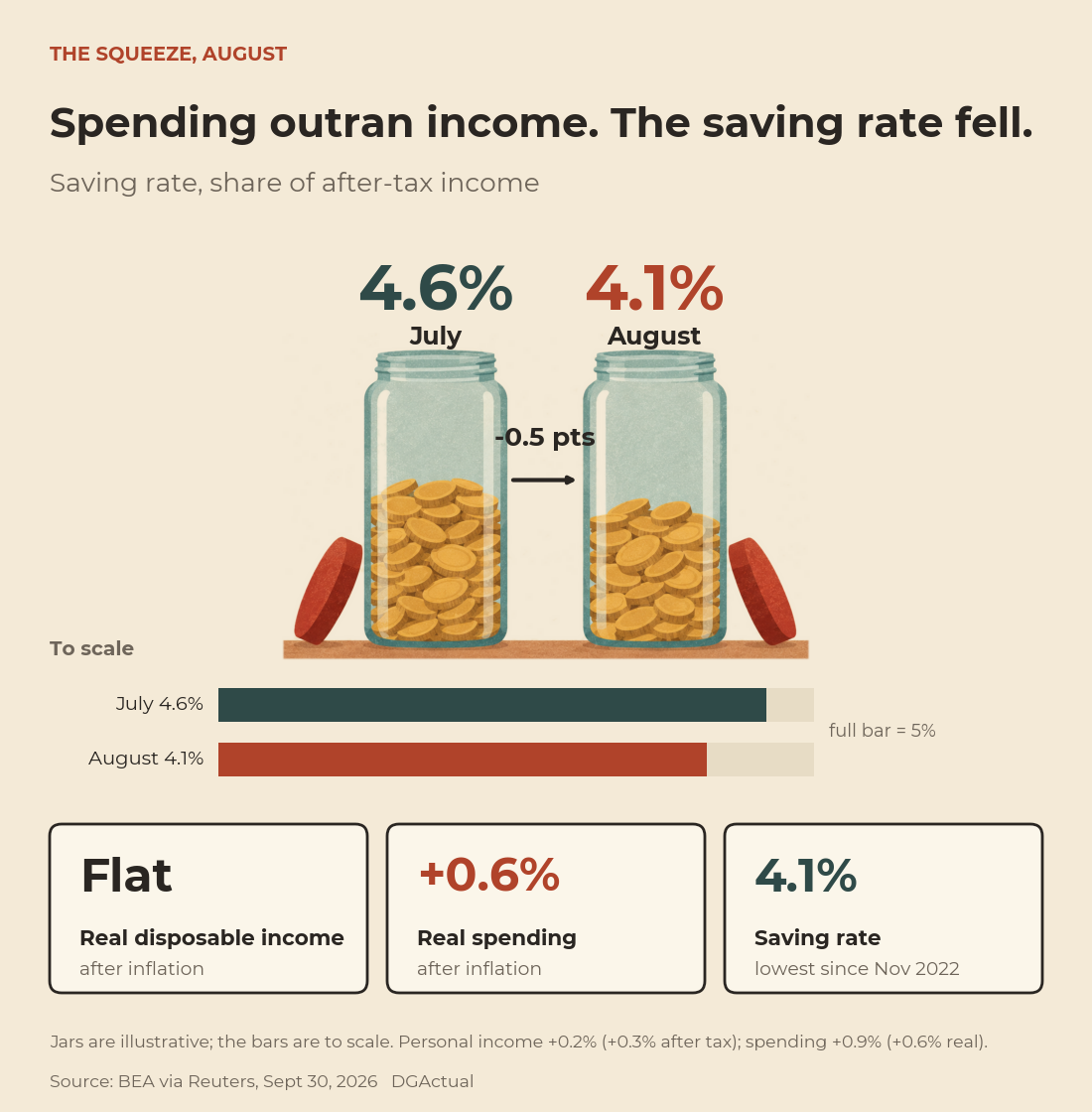
Gregory Daco, chief economist at EY-Parthenon, told the Wall Street Journal where the rest is coming from. People are using their savings, using credit and using wealth, and trying to find different ways to finance their outlays. The Journal adds that Americans are taking on record levels of debt, and that the savings and credit are finite. Finite is the word to hold onto. One month of data shows the direction, and not much more than that.
So what would change our mind? A rising saving rate alongside falling retail sales would mean households have started to pull back, which is what the sentiment numbers say should be happening. Thursday brings the first estimate of third-quarter GDP and the September saving rate, both at 8:30 a.m. Friday’s Employment Cost Index tracks what employers pay for labor. Together they will show how much of this spending is backed by income. AP notes that average wages are stagnating while costs eat more of household budgets, and in our read, wages are the piece that decides whether this can last.
A note from the workshop
We are retooling. Over the next few weeks we are sharpening the instruments behind our weekly brief, and we would rather give you two features worth reading than a thin brief with the same three charts.
One of the new tools is a hot list tracker, an early-warning list of used models whose demand starts rising before it shows up in national numbers or in asking prices. It watches the whole country plus eleven local markets. Six of them are in the Sun Belt, where we expect demand to move first, though we will test that expectation against real data before we lean on it. The tracker’s main job is telling a real move from ordinary noise, because a model that sold twice as many units in one small market last week may just have had a good Saturday. It is still in testing and has not produced a published signal. We will tell you when it has earned one.
Coming up: we check our own homework
On December 31, 2025 we published our predictions for 2026: markets, consumers, auto retail and risk. We called 2026 a sorting year, not a recovery year, and put new-vehicle sales near 15.8 to 16.0 million units. The third quarter has already come in above that range, at 16.65 million, so that call is not looking like our best one. The year is not over, and we are not going to grade ourselves in October. Once the data is in, we will reconcile every call against what happened, right and wrong, with the same sourcing rules we use on everyone else.
The regular Monday brief returns next month.
Bottom Line
The market hands every dealer the same average, and the average is where gross gets lost. Daniel Govaer’s Monday Signal Brief reads what’s under it: the segments, models, and model years actually moving your numbers, every Monday before your week starts. Read this week’s full brief at dgactual.com and price to where the market’s heading, not where it sat last month.

Right on Cue
get in the game
Sign up for our newsletter to get regular updates on new, resources, partnerships, features, and other important announcements from VINCUE.
Related Content






Our Dealers Can’t Stay Quiet on Google

Launched VINCUE a couple months ago for our dealership as we were previously on vAuto. We love the pricing, software, and the support team is engaging with a lot of new features coming. It was a GREAT decision to switch from vAuto to VINCUE and we are very happy with the new software and support team.
Brandon Bizzell
General Manager
The Faricy Boys Chrysler Jeep
Salida, CO

New to the VINCUE family, and I’m very impressed with the immediate support provided by the team. Charlie Basham has been a key factor in getting the dealership started on a great path with the VINCUE system. He has been very responsive to my questions and has made sure I can navigate the key reports and understand the process used. Cheyenne Currier has also been very responsive with merchandising uploads needed by the dealership. I look forward to working with the VINCUE Team in the future.
Lynn Burns
Used Car Manager
Sierra Toyota
Sierra Vista, AZ

Was previously with another provider for 16 years but now have been with VINCUE for 6 months and I absolutely love it and would never go back to my old provider. Even if you’re not considering making any changes right now, this is one I would look into and you won’t regret it! What I realized is how behind the times my previous provider is and I didn’t even realize it until I learned about VINCUE!
Mark Owen
General Manager
Cable Dahmer Automotive
Kansas City, MO