

Record Payments, a Split Credit Picture, and Used Prices Continue Trend
It’s the Monday before Thanksgiving, and the finance office has one quiet hour before the holiday traffic. On one side of the desk sits a buyer about to sign for the most expensive November car on record, at a payment no November buyer has carried before. On the other sits a subprime file that took three lenders to place. Both deals say something true about this market, so this week we take them one at a time.
Overview
First, why record prices haven’t stopped buyers. Second, why late payments are climbing in one corner of auto credit while the overall picture gets better. After that come the Fed, our used-price index, the auction lanes, private sellers, the sales pace, one large airbag recall, a short holiday calendar and an editorial on the lease we keep skipping.
Record Prices, and the Buyers Who Sign Anyway
Start with the sticker. JD Power and GlobalData expect the average new vehicle to sell for $47,154 in November, a record for the month. The average monthly payment should land at $840, also a November record.
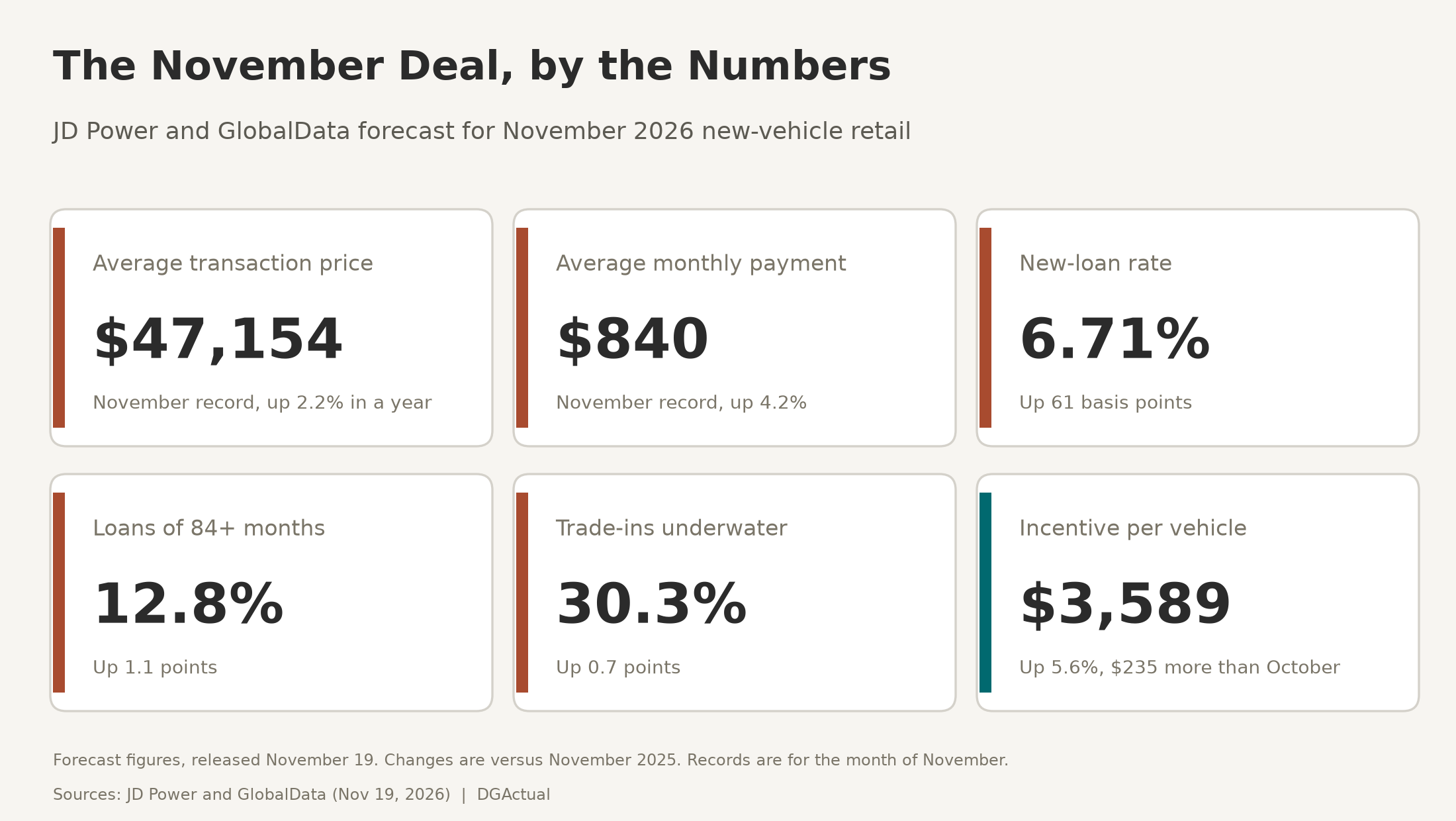
The loan got pricier, too. The average new-car rate is forecast at 6.71%, up 61 basis points from a year ago. A basis point is one hundredth of a percentage point, so that’s a little more than six tenths of a point.
Buyers are stretching to make it work. About one new-car loan in eight now runs 84 months or longer. Close to a third of trade-ins are worth less than what’s still owed on them. That’s called negative equity, and it usually gets rolled into the next loan.
So why do people keep signing? Three reasons show up in the data. The first is factory money. JD Power’s Thomas King said “manufacturers are leaning into discounts to keep buyers in the market.” Incentives are running about $3,589 per vehicle.
The second is the fuel bill. Hybrids are on track for 18.3% of retail sales. King tied the shift to “elevated fuel prices and increased availability of hybrid vehicles.” Electric vehicles got back to growth as well, even with their discounts much smaller than a year ago.
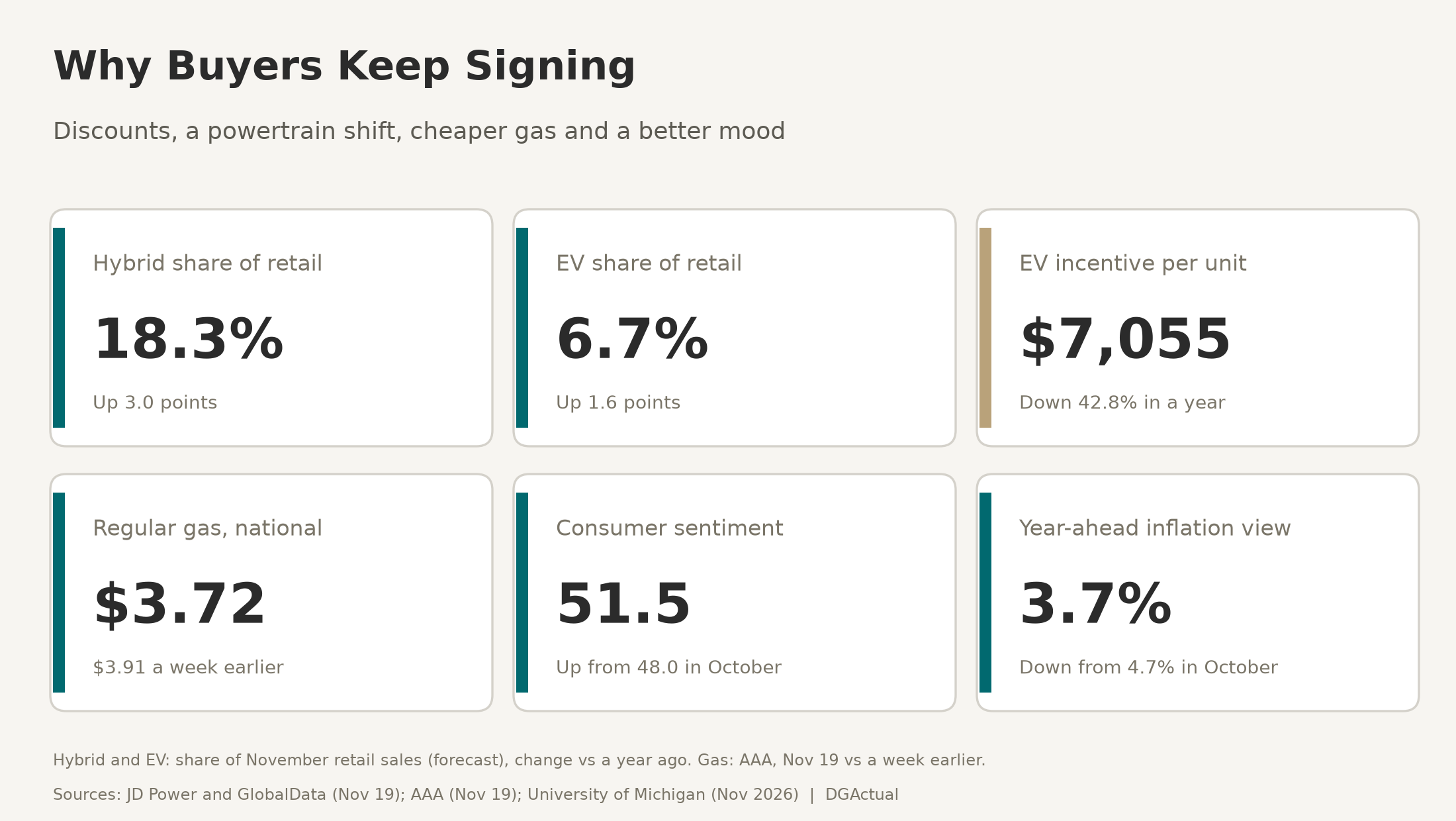
The third is mood. The University of Michigan’s consumer sentiment index rose to 51.5 in November. Its survey director said lower- and middle-wealth households “experienced some relief with falling gas prices.” AAA had regular gas at $3.72 on November 19, about 19 cents below the week before.
Two cautions. These are forecasts, made before the month is over. And total sales grow 1.2% only after adjusting for the number of selling days. Without that adjustment, the count is down 6.9%.
What would change our read? Watch the incentive line. If factory money flattens while rates keep rising, the record payment loses its cushion, and the long-loan share is where the strain would show up first.
Subprime Strains While the Average Improves
Now the other file. Fitch Ratings tracks auto loans that lenders bundle into bonds and sell to investors. In the subprime bonds it rates, 6.3% of loans were 60 or more days behind in October. Fitch says that’s above both the global financial crisis and pre-pandemic levels.
Prime borrowers in the same kind of bonds look fine, hovering around 0.5%, Fitch says. The split shows up in pricing as well. Subprime used-car loans now carry rates above 19%.
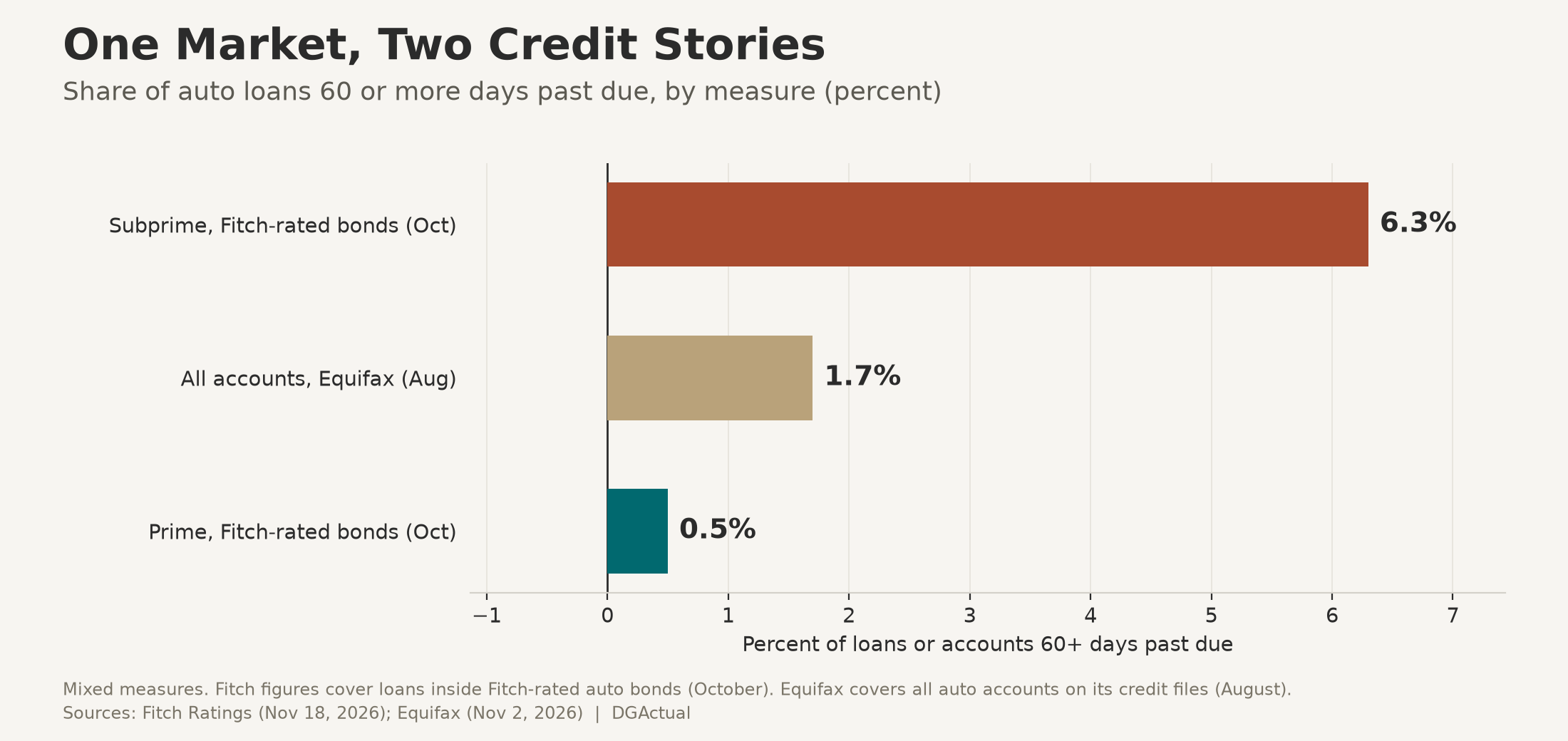
Zoom out and the trend reverses. Equifax counted 1.7% of all auto accounts 60 or more days late in August, an improvement from a year earlier. Banks in particular cut back on subprime lending, Equifax says.
How can both be true? Part of the answer is mix. When lenders approve fewer of the riskiest borrowers, the overall average can improve even while the subprime borrowers already on the books struggle. One number pushes the other way: Equifax says the subprime share of new loans rose to 17.6%.
We can’t tell from these reports how much of the gap is mix and how much is fresh strain. Fitch measures the bonds it rates. Equifax measures every auto account on its files, and its figure is two months older. We’d rather say that than guess.
For a store, this lands in F&I. A subprime approval at today’s rates puts the payment near the edge before the first one is due. Roll negative equity into that loan and the buyer starts further behind. Structure the deal around the payment the customer can still make in month twenty, not just the one that gets the contract signed.
What would change our mind? If the broad numbers start rising too, the strain is spreading past subprime. Until then, it’s a tier problem, and it’s worth knowing which tier your buyers sit in.
The Fed Leans Toward December
Minutes from the Fed’s October meeting, released Wednesday, November 18, showed “almost all” policymakers expect more rate hikes to be needed. “A couple” raised a half-point move if inflation data came in hot, Reuters reported.
Mortgage rates already moved. Freddie Mac’s 30-year average rose to 7.28% on November 19, from 7.11% a week earlier. The Fed’s next rate decision comes Wednesday, December 9.
DARPI
DARPI is our used-price index. It tracks used retail asking prices from dealer listings across 11 vehicle segments, indexed to 100 at June 8. Every segment is at data.dgactual.com.
The Near-New index fell 0.28 points week over week, to 92.43. That’s its 19th straight decline, a run of readings that began on July 17.
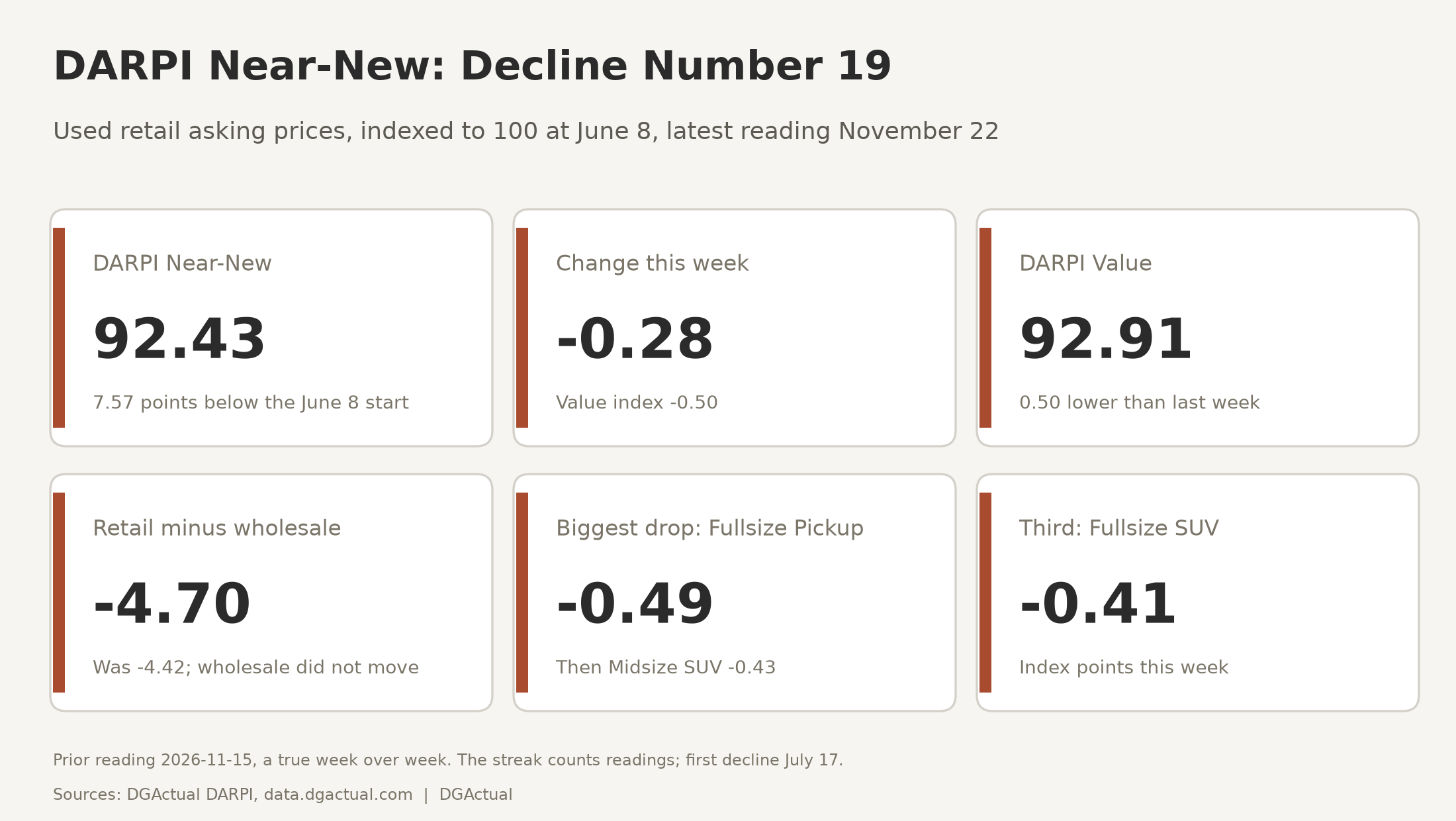
Since June 8, dealer asking prices are down 7.57 points, while the Manheim wholesale index, rebased to the same start, is down 2.87. Retail has fallen about 2.6 times as far. Wholesale didn’t budge in this reading, so the wider spread came entirely from dealer asking prices.
Fullsize Pickup, Midsize SUV and Fullsize SUV fell the most. The EV segment went the other way, up 0.41. One limit to keep in mind: DARPI tracks what dealers ask, from one listings provider. It doesn’t measure what cars sell for.
Auction Lanes
Wholesale is what dealers pay at auction. Black Book’s latest weekly report, for the week ending November 14, had wholesale values down 0.93%. That’s a steeper drop than the 0.63% average for the same week in 2017 to 2019.
Trucks and SUVs fell harder than cars. Still, 58% of vehicles offered at auction sold, up two points, which Black Book called “a positive signal for buyer demand.”
FSBO Desk
FSBO means for sale by owner: private sellers listing a car themselves, not through a dealership. The spread is the private seller’s asking price minus the dealer’s, on cars matched for mileage, model years 2022 to 2025.
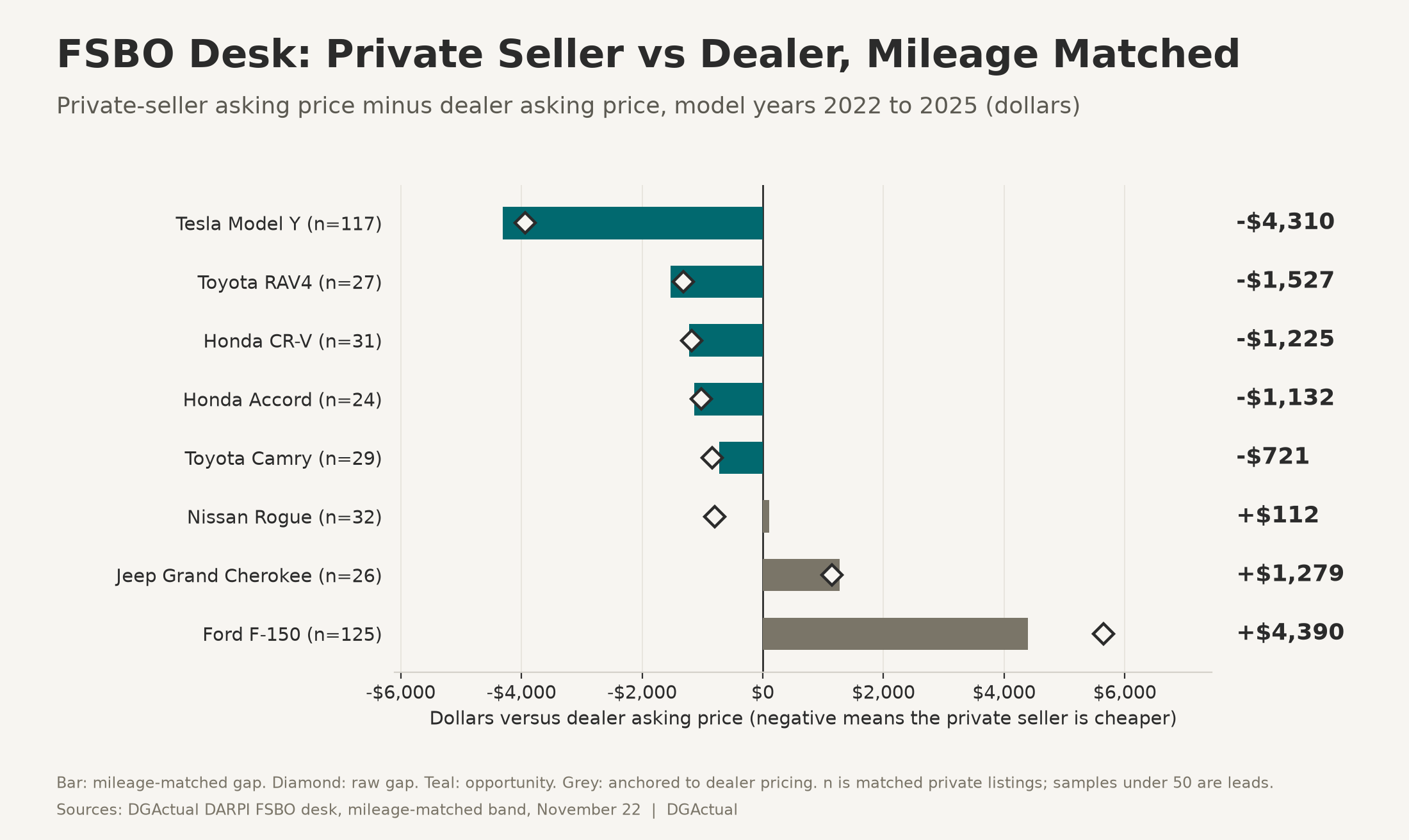
Two models have deep samples. Private Tesla Model Y sellers are asking $4,310 below dealers, on 117 matched listings. Private F-150 sellers are asking $4,390 above dealers, on 125, so trucks stay anchored to dealer pricing.
The RAV4 gap widened to $1,527 below dealers on 27 matched listings, from $678 a week earlier. The CR-V, Accord and Camry also show private sellers cheaper, each on fewer than 35 matched listings, so treat them as leads.
The Rogue flipped. A week ago private sellers were $1,332 cheaper after matching mileage. Now they sit $112 above dealers on 32 matched listings, which moves it to anchored. Private Grand Cherokee sellers remain $1,279 above dealers, on 26.
The Sales Pace
SAAR is the seasonally adjusted annual rate: how many new vehicles the market would sell in a year at the current pace. Our model puts the fourth quarter at 16.23 million, on the government’s count, which includes heavier trucks. In our tests it hasn’t yet beaten simply assuming next quarter looks like this one, so read it as a direction.
JD Power and GlobalData expect a 15.7 million pace for November, down 0.2 million from a year ago. The two counts are built differently, so don’t subtract one from the other.
Safety Desk
Honda is recalling 810,592 vehicles with certain Takata front air bag inflators: some 2012 to 2013 Honda CR-Vs and Civics, the 2013 Accord, and the 2013 Acura RDX and ILX. NHTSA’s filing says the inflators may rupture.
These cars are 13 to 14 years old, so plenty have changed hands since they were new. The service lane’s best shot is a VIN check on every older Honda and Acura that comes in, trade-ins included.
Week Ahead
Tuesday, November 24, brings the Conference Board’s November consumer confidence survey at 10 a.m. Wednesday, November 25, is crowded. At 8:30 a.m. comes the government’s second estimate of third-quarter GDP, plus the October personal income and spending report, which carries the Fed’s preferred inflation gauge. The Fed’s Beige Book, a roundup of business conditions from its 12 districts, follows that afternoon.
Stock markets close Thursday, November 26, for Thanksgiving. Friday, December 4, brings the November jobs report and Michigan’s preliminary December sentiment reading. The Fed decides on rates Wednesday, December 9.
Editorial: The Lease We Keep Skipping
Did you ever notice that a car loan now lasts longer than the car feels new? About one new-car loan in eight runs 84 months or longer. That’s seven years. Most people don’t keep a gym membership that long, and they at least meant to use the gym.
The plan goes like this. A few years in, the customer wants a different car. The old one is worth less than what’s owed, as close to a third of trade-ins are. The difference gets added to the new loan, which then needs a longer term to make the payment work. Repeat as needed. It’s less a financing strategy than a subscription to being underwater.
Meanwhile, the lease sits on the desk like the salad at a steakhouse. Everyone knows it’s there. Nobody orders it. Ask around and you’ll hear leases aren’t really a good deal, usually from someone who hasn’t priced one in years. So I run both on the same car, in the store, and the room gets very quiet. In my experience, the 36-month lease comes in $80 to $150 a month under the long loan. Someone usually checks the calculator twice.
The negative equity doesn’t disappear, which would be nice. It gets folded into the lease and paid off in three years, instead of being handed down to the next car like a family heirloom nobody wanted. At the end, barring mileage and wear charges, the customer gives back the keys and owes nothing. An 84-month borrower at the same point has four years of payments left, possibly on a car they no longer own.
Leases have real limits: mileage caps, wear charges, nothing to own at the end. Some customers should buy. But with the average payment at $840 a month, we keep reaching for the longest loan on the menu out of habit. Nobody is making us skip the lease. We’ve managed that on our own.
Bottom Line
The market hands every dealer the same average, and the average is where gross gets lost. Daniel Govaer’s Monday Signal Brief reads what’s under it: the segments, models, and model years actually moving your numbers, every Monday before your week starts. Read this week’s full brief at dgactual.com and price to where the market’s heading, not where it sat last month.

Right on Cue
get in the game
Sign up for our newsletter to get regular updates on new, resources, partnerships, features, and other important announcements from VINCUE.
Related Content




Our Dealers Can’t Stay Quiet on Google

Launched VINCUE a couple months ago for our dealership as we were previously on vAuto. We love the pricing, software, and the support team is engaging with a lot of new features coming. It was a GREAT decision to switch from vAuto to VINCUE and we are very happy with the new software and support team.
Brandon Bizzell
General Manager
The Faricy Boys Chrysler Jeep
Salida, CO

New to the VINCUE family, and I’m very impressed with the immediate support provided by the team. Charlie Basham has been a key factor in getting the dealership started on a great path with the VINCUE system. He has been very responsive to my questions and has made sure I can navigate the key reports and understand the process used. Cheyenne Currier has also been very responsive with merchandising uploads needed by the dealership. I look forward to working with the VINCUE Team in the future.
Lynn Burns
Used Car Manager
Sierra Toyota
Sierra Vista, AZ

Was previously with another provider for 16 years but now have been with VINCUE for 6 months and I absolutely love it and would never go back to my old provider. Even if you’re not considering making any changes right now, this is one I would look into and you won’t regret it! What I realized is how behind the times my previous provider is and I didn’t even realize it until I learned about VINCUE!
Mark Owen
General Manager
Cable Dahmer Automotive
Kansas City, MO